Those Who Swift - Issue 275

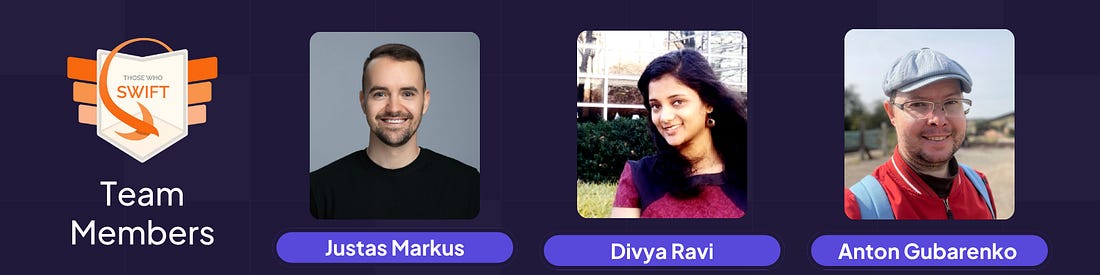
Weekly note ✏️We have a new team member! 🙋♀️ Divya Ravi, Senior iOS Engineer at Unity and creator of FoundationModelsKit, is joining Those Who Swift as a new newsletter editor. If you’d like to get to know Divya, check out her LinkedIn and X.
Anton isn’t going anywhere! He’s now the editor of our new website - which brings me to the second big news. 🥳 We now have a blog with unique, quality content. New content, collaborations, partnerships, special deals, and more coming soon. Stay tuned! 😎🤘
Own Your web2app Funnel and Get Paid in Daysweb2wave lets subscription apps sell on the web first: users complete a quiz flow, pay, then download the app with an active subscription. The sale closes before install, so you don’t pay 15-30% app store fees on it.
Payment coverage in web2app: direct integrations with Paddle, Stripe, Solidgate, FastSpring, Zotlo, Unlimit, Xsolla, PayPal, Billerix, and 100+ more via Primer. Free to use until you launch paid traffic.
Post-WWDC26: The 3 On-Device AI Patterns That Will Actually Ship This Yearwith Divya Ravi — Technical Editor & iOS engineer, creator of FoundationModelsKit Every June, WWDC produces the same split-screen reaction: a keynote full of features that sound revolutionary, followed by a developer community quietly asking which of them will actually be usable in a shipping app before next June. This year is no different. Between Siri AI, Private Cloud Compute, and a redesigned Foundation Models framework, there’s a lot to sort through — and most of the coverage so far has just listed announcements rather than telling you what to actually build against. So here are the three patterns from WWDC26 I think are worth architecting around this cycle — not because they’re the flashiest, but because they’re the ones you can ship on, today, without waiting for a keynote demo to become real. 1. Model portability is no longer a side project — it’s a protocol. Apple’s new LanguageModel protocol means your app’s AI logic doesn’t have to be married to Apple’s on-device model anymore. Swap in Claude, swap in Gemini, or fall back to on-device — all through the same session interface, with your tool calls and context management untouched. In practice, this turns a decision that used to require re-architecting your AI layer into a Swift Package Manager dependency change. Why it matters: most teams have been quietly hedging against being locked into Apple’s model quality, especially for anything requiring nuanced reasoning. This protocol makes that hedge free. If your app currently has model logic tangled into your view layer or business logic, this is the year that tech debt gets expensive — everyone else’s app is about to be able to swap providers in an afternoon, and yours won’t be if the session boundary isn’t clean. 2. Bring-your-own-model finally has a real home: Core AI. Core AI is Apple’s new answer to teams who don’t want to use Apple’s model at all — a full on-device deployment framework with a Python conversion pipeline and a Swift runtime, tuned to run across CPU, GPU, and Neural Engine without a server dependency. This has existed in rougher form via Core ML for years, but Core AI is the first version that feels like a first-class platform citizen rather than a workaround. Why it matters: if you’ve been holding off on shipping a proprietary or fine-tuned model because the on-device tooling felt like a science project, that excuse is gone. The teams who move now — while most of the ecosystem is still only using Apple’s default model — get a real differentiation window before “on-device AI” becomes table stakes and looks identical across every app in a category.
3. App discovery is moving into the OS, not your app’s UI. Between the Spotlight semantic index, App Intents schemas, and the new View Annotations API, Apple is making a clear bet: the primary way people invoke your app’s functionality is about to be Siri asking on their behalf, not someone tapping your icon. Annotate your views, expose your actions through App Intents, and your content becomes something the system can reason about and act on — conversationally, without you building any of that interface yourself. Why it matters: this is the one pattern that’s easy to underestimate because it doesn’t produce a flashy demo. But it’s the one most likely to quietly redefine what “distribution” means for an app over the next two years. Ignore it and you’re opting out of an entire invocation surface your competitors will be inside of. The thread connecting all three Model portability rewards apps with clean session boundaries. Core AI rewards apps that already separate inference from UI. App Intents rewards apps that expose actions as first-class objects instead of burying them in view controllers. None of this is really about AI capability — it’s about whether your architecture was ready for it. If you’re planning your roadmap around this WWDC cycle, the highest-leverage work isn’t picking which shiny feature to bolt on first. It’s making sure your architecture can say yes to any of the three. Agree, disagree, or think I’m missing a pattern? Just hit reply — I read every one. Apple 🍏Foundation Models in iOS 27: Tool-Calling ControlBlake Crosley digs into the new ToolCallingMode API and Apple’s built-in OCR and barcode tools — the kind of detail that matters once you’re past the keynote demo and into shipping.
Read more.📍Level: AdvancedApple’s WWDC26 AI Story Is About Control, Not Just ModelsJon Brown’s read on the keynote pairs directly with this issue’s essay — if you only click one link this week, make it this one.
Read more.📍Level: IntermediateWWDC 2026 Developer Tools: Xcode 27, Swift, Foundation ModelsA blunt, opinionated take — and one I don’t think is right, which is exactly why it’s worth reading.
Read more.📍Level: IntermediateTutorials 📒Getting Started with Apple’s Foundation ModelsArtem Novichkov builds a HealthKit-powered health coaching feature using a custom Tool — the most practical, code-first entry point in this issue.
Read more.📍Level: Beginner
Introducing FoundationModelsKit: Production Patterns for Foundation Models on iOSFull disclosure: this one’s mine — including it because it’s directly on-theme for this issue, not just because I wrote it. At WWDC26, Apple made a bold move: Foundation Models now ship with iOS, on-device, with no download or external dependency.
Read more.📍Level: IntermediateCoding 👨💻SwiftUI Best Practices, straight from Apple’s Xcode 27 Agent SkillAntoine van der Lee dissects the actual Markdown reference files Apple bundled into Xcode 27’s SwiftUI agent skill — and it’s basically a written confirmation of this issue’s whole thesis.
Read more.📍Level: IntermediateSwift Bits: My Top Xcode CI Environment VariablesAnton digs into Apple’s environment variable reference for Xcode Cloud — unglamorous, but exactly the kind of thing that saves you an afternoon of debugging why CI behaves differently from your local machine.
Read more.📍Level: IntermediateDesign 🎨5 biggest Liquid Glass changes in iOS 27 and macOS 27A clear rundown of how Apple is walking back a year of Liquid Glass complaints — legibility, corner-radius consistency, and icon clarity all got real fixes this cycle.
Read more.📍Level: BeginnerOther cool stuff 🧰How I use FlowDeck to let my AI agent build and run my appsDonny Wals on folding an agentic coding tool into his existing workflow — a good counterweight to the rest of this issue, since it’s about AI helping you build, not AI features inside what you ship.
Read more.📍Level: IntermediateVideo 🎥Build intelligent Siri experiences with App SchemasStraight from Apple’s own WWDC26 session — Dan Niemeyer walks through exactly how Siri understands and acts on your app’s content, which pairs directly with pattern 3 in this issue’s essay.
Watch here.📍Level: IntermediateThanks for reading! Got a pick worth featuring? 📬 Use the submission form and share with more than 15,000 developers. Thanks for reading Those Who Swift! Subscribe for free to receive new posts. 👇
|