Those Who Swift - Issue 256
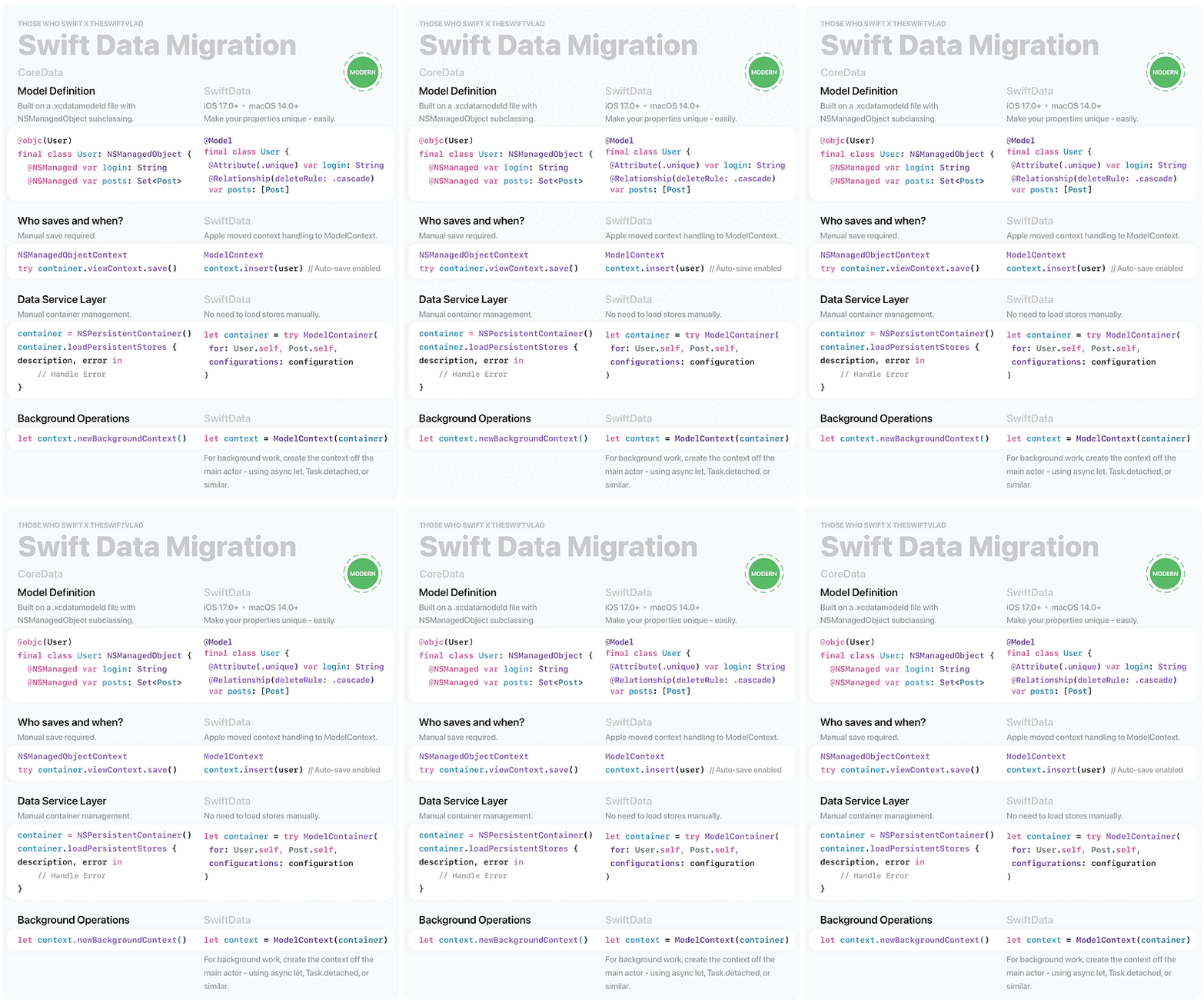
Weekly note ✏️The modern world shows that critical shifts no longer take months or even days. Sometimes they happen in minutes. Thanks to instant communication channels, reactions are immediate and consequences follow just as quickly. A recent example: Anthropic publicly stated that it will not allow broad usage of its models for military or large-scale surveillance purposes in the U.S. government. Leaving the ethical debate aside, especially considering that OpenAI has taken a different position. This move had an immediate market effect. The Claude app climbed to the top of the AI category on the App Store. Even more interesting, Anthropic released a migration guide explaining how to switch from other AI chat tools to Claude. You can find more details in our AI section. This raises an important question. We all know how critical backend redundancy is. Should we now think about AI tool redundancy as well? Diversity always intersects with security. Relying on a single provider, whether for infrastructure or AI, increasingly feels risky. Apple is making its own moves in the backup space. Time Machine will soon drop support for Time Capsules formatted with AFP (Apple Filing Protocol). Official support ends with macOS 27, expected in Fall 2026. AFP is being phased out in favor of SMBv2 and SMBv3 for network file sharing. The hardware itself was discontinued in 2018, and most units are already past their expected lifespan. While a Time Capsule can still function as a Wi-Fi router, it will no longer serve as a reliable backup target for newer macOS versions. If you’re affected, alternatives include a fast external USB drive connected directly to your Mac, a NAS device such as Synology or QNAP that supports Time Machine over SMB, or a modern router with USB/NAS functionality. Cloud backup services like Backblaze or iCloud can also help, though they don’t replace the full-system snapshot model of Time Machine. On iOS, we’ve long had Core Data as a built-in persistence solution, and now SwiftData continues to evolve that experience. As part of our collaboration, we’re sharing a SwiftData migration tip from Vlad Tretiak in this issue. Stay safe, and more importantly, keep your data safe.
Connect with the "Those Who Swift" team - Justas Markus & Anton Gubarenko 👋 Sponsor 🤝Forget about Ruby and Fastlane installation issues!Discover Codemagic CLI tools — the free, open-source Fastlane alternative for automating iOS builds, code signing and publishing. Swift Around the Web 🌐Modularizing Swift Apps with Swift Package ManagerKyle Browning explains how to split a large iOS app into independent modules using Swift Package Manager. By separating features, shared utilities, and dependencies into packages, teams gain faster builds, clearer boundaries, and safer parallel development. iOS Backend Security Series: Request Signing & Quantum-Safe TLSThis post explores strengthening iOS-to-backend security with request signing and quantum-resistant TLS. It explains how signed requests verify authenticity and integrity, and why preparing for post-quantum cryptography helps protect APIs against future attacks. Announcing Swift 6.2.4The Swift Org has released Swift 6.2.4, a patch update focused on quality and stability improvements across the language, standard library, and tooling, aimed at smoothing the developer experience. Coding 👨💻Geometry in SwiftUI ExplainedSagar Unagar breaks down how layout geometry works in SwiftUI, covering tools like NSCache in SwiftArtem Mirzabekian shares how to use NSCache effectively in Swift to store temporary objects like images or data, avoid memory bloat, and improve app performance with simple caching patterns. Design 🎨All In on Interface Builder: 10 Years LaterScott Berrevoets reflects on a decade of using Interface Builder at scale, sharing lessons about maintainability, collaboration, and when visual tooling truly helps versus when it hinders productivity in Swift and UIKit projects. Other cool stuff 🧰Notepad.exe - A Notepad for DevelopersMy friend Marcin Krzyzanowski, who many of you probably know, developed Notepad.exe. It’s a lightweight coding scratchpad for macOS, built for experiments, snippets, and rapid prototyping. Open it, write your code, and run it - no project setup required. The Hidden Cost of CommunicationThis article by Joe Fabisevich explains how excessive meetings, messages, and coordination overhead quietly reduce engineering productivity. It argues that clear ownership, better documentation, and asynchronous workflows help teams ship faster by minimizing unnecessary communication. Automating Mac App ScreenshotsAmy Worrall shows how to automate App Store screenshot creation for macOS apps using scripts and UI automation, reducing repetitive manual work. The approach enables consistent, reproducible marketing assets across updates while saving significant release time. AI 🤖Developers Are Safe… Thanks to Corporate Red TapeMohammad Azam argues that despite rapid advances in AI coding tools, software developers aren’t being replaced: only their workflows are changing. The focus is shifting from writing every line of code to problem-solving, architecture, and validation, making human judgment and domain knowledge more valuable than ever. Importing Memory into ClaudeClaude’s memory import feature lets you upload documents and notes so the assistant can remember key context across conversations. It helps personalize responses and maintain continuity for ongoing projects, research, or workflows. Using Voice Mode in ClaudeClaude’s Voice Mode lets you have fully spoken conversations with the assistant instead of typing. You can talk naturally and hear Claude’s responses, switch between text and voice in the same chat, and choose between hands-free listening or push-to-talk depending on your environment. GPT-5.3 InstantOpenAI has introduced GPT-5.3 Instant, an update to ChatGPT’s most widely used model designed to make everyday conversations smoother and more helpful. It improves response accuracy, provides richer web-context answers, reduces unnecessary refusals or disclaimers, and aims to keep interactions flowing naturally while cutting hallucinations and improving reliability. Tutorials 📒Juice It Up With UIKit DynamicsThis tutorial from Whacky Labs shows how to add physics-based motion to your UIKit interfaces using UIKit Dynamics, making UI elements feel alive with gravity, collisions, springs, and other real-world behaviors for more engaging interactions. Video 🎥Staff Engineering in Mobile Teams: Myth vs RealityThis Swift Academy Podcast episode explores the real role of a Staff iOS Engineer and how it differs from a Tech Lead or “Senior++”. With guest Firas Safa (GetYourGuide, former Yassir), the discussion covers expectations, leadership responsibilities, and the broader architectural and cross-team impact of the Staff position in mobile teams. Building a Reusable Network Manager in SwiftThis first video in a new series walks through creating a reusable NetworkManager for Swift and SwiftUI projects using async/await and URLSession. It focuses on designing a flexible, generic networking layer with proper HTTP validation, improved error handling, and configurable decoding strategies - so you can cleanly fetch and decode models without hard-coding assumptions. Thanks for reading Those Who Swift! Subscribe for free to receive new posts.
|