|
Over the last few weeks, there's been a massive change in the way we interact with AI and agents. |
I've been talking about the changes as they've been coming out -- both in this newsletter and on LinkedIn. But after finally wrapping my head around everything, I can now confidently say: the next wave of AI agents is here. |
Between OpenAI-owned OpenClaw, Meta's Manus Computer, Perplexity's Computer, and now Anthropic's new Dispatch feature, we're seeing a fundamental shift in what AI agents can do. |
In sum, we're moving from chat sessions to persistent loops, isolated tasks to autonomous workflows, and "AI helps me code" to "AI works while I sleep." |
So in today's newsletter, I want to break down: |
What makes these new agent systems fundamentally different What to expect (hint: you'll be busier, not less busy) How to prepare: the meta-skill that actually matters
|
—@dharmesh |
|
What You Need to Understand: The Agent Control Layer |
These new systems aren't chat interfaces. They're a fundamentally different layer. |
What makes them different is that they can run persistent loops with richer memory, have their own sandbox environments, and autonomy to act when you're not watching -- including multi-agent setups with personalities that feel like real teammates. |
OpenClaw was the clearest example of this shift, but you can do similar things with Meta's Manus Computer, Perplexity's Computer, and now Anthropic's new Dispatch feature. |
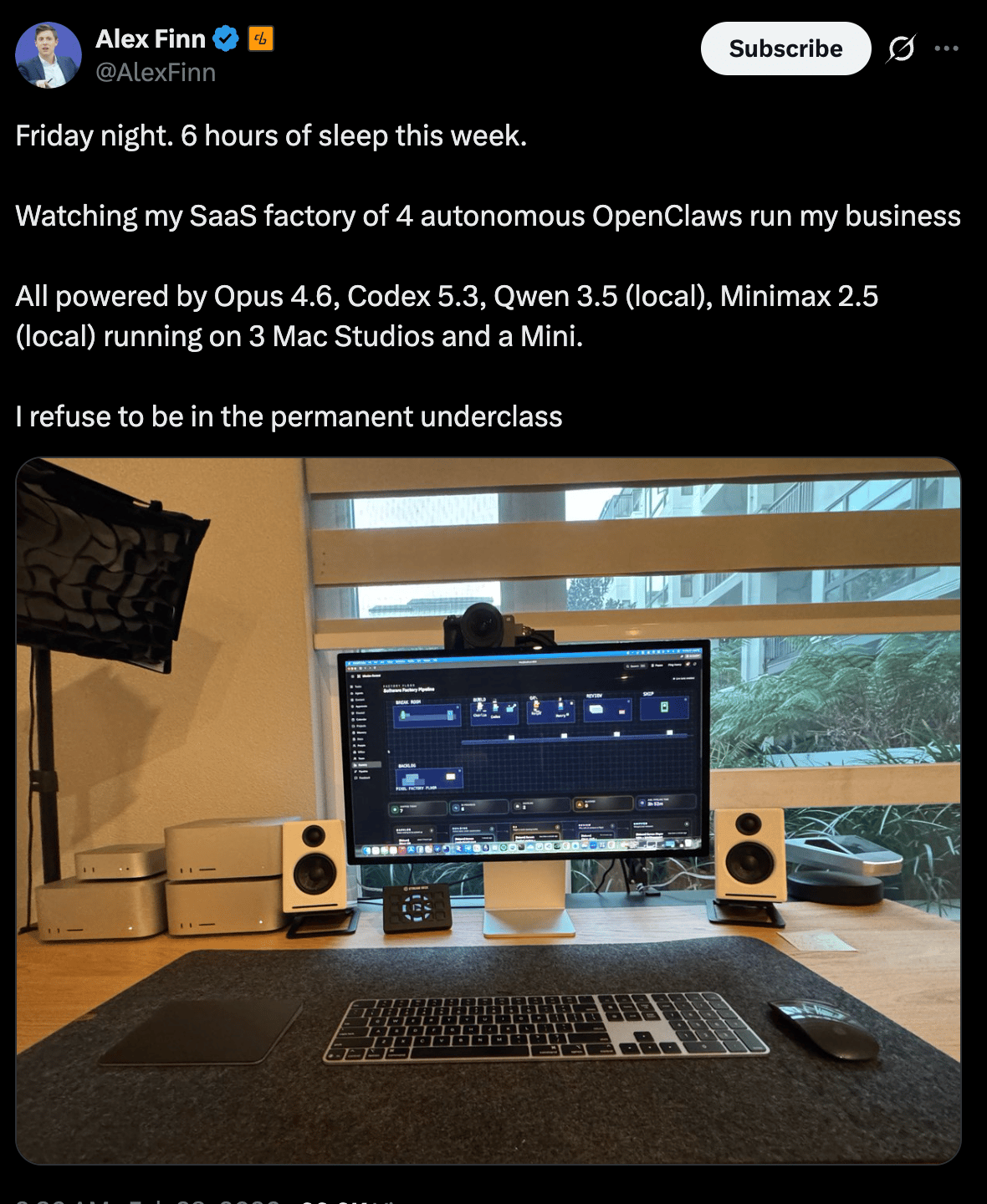
If you're chronically online like I am, you've probably seen influencers posting images of their 5+ Mac Minis, each running a different OpenClaw personality. |
|
A bit excessive? Maybe. But there's a good reason for it. |
Agents take time to do work. So having multiple AI agents, each with a different personality (defined in markdown .md files), allows you to give them work simultaneously. |
You turn into an "orchestrator" and "reviewer" of their work rather than doing the work yourself. |
|
The AI Agent Overwhelm Paradox |
As incredibly exciting as this all is, and as much as it's creating near-infinite opportunities for how we work, there's something strange happening: how overwhelmed and exhausted many people feel. |
I haven't heard many people talk about this out loud, but it feels like people are feeling it. Including me. Don't get me wrong. I love AI and what it lets me do, but it feels like things are progressing at a frenetic place and it's easy to just get caught up in the frenzy and not be able to take a breath. |
You might think AI agents will make you less busy. That you'll delegate tasks, get time back, maybe even relax. |
But that's not what actually happens. |
Developers using these systems are busier than ever. |
Every workflow they automate reveals more workflows worth building There's a constant "anxiety" to keep these agents running when they stop You're managing a fleet of agents for 16 hours a day rather than the usual 8-hour workday Every hour you stop means your agents are just sitting there, waiting for your instructions
|
The constraint isn't capability anymore. It's attention and workflow design. |
If you're reading this newsletter, you're likely feeling similarly. |
My best advice: zoom out and realize how early we all are to this. The way we work is changing, but the pace feels faster than it actually is. |
If you're online and learning (including reading this article), you're already likely ahead. You don't need to run 5 Mac Minis to stay relevant. (But yes, when you get a chance, try out one of the new autonomous agents — in a safe/contained way — just so you get a feel for what's possible now). |
|
How to Prepare |
The good news: I don't think the 16-hour-workday anxiety will last forever. |
Soon, agents will control each other. I've written about multi-agent systems before -- this is where we're headed next. Agents will coordinate directly, invoking each other when they need specific capabilities. |
Humans will slowly be removed from optimization loops. Then, the goal will be to set objectives, metrics, and boundaries, and let agents run for long periods without you. Humans will contribute ideas, but won't manually enact most experiments. |
When we get to this point, agents will need less human oversight. That means fewer 16-hour days. |
But until then, if you want to be on the bleeding edge of what's currently possible, you need to constantly manage the agents. |
Practically speaking, there are two paths you can take right now: |
Be at the forefront and chase every new agent update.
This means a similar path to what I'm doing -- 16-hour days, trying every new tool, setting up environments for agents to run in (like a separate computer or virtual system in the cloud), constantly setting up new agents. You'll get some early benefit, but it's exhausting. Start collecting data and designing systems.
Start identifying automatable workflows in your daily work. Design objectives and metrics. Collect the right data. Build systems so you're not the bottleneck (tip: it's the same as giving good context to ChatGPT -- just systematized).
|
Even just following Path 2 is a very viable strategy for now and will put you in the top 0.1% of early adopters. |
You follow along with people on Path 1 (if you're reading this newsletter, you have me). You prepare the data and systems now. And when agents can truly run autonomously, you're ready. |
The key thing is to stay objective and realize where the hype lies. |
Not every workflow needs AI. But the ones that do? Start identifying them and building mental models around them now. |
When agents can truly run autonomously and coordinate with each other without human oversight, you'll be ready. |
The next wave is here. It's time to build! :^) |
—Dharmesh (@dharmesh) |
|
|
What'd you think of today's email?Click below to let me know. |
|