Those Who Swift - Issue 253
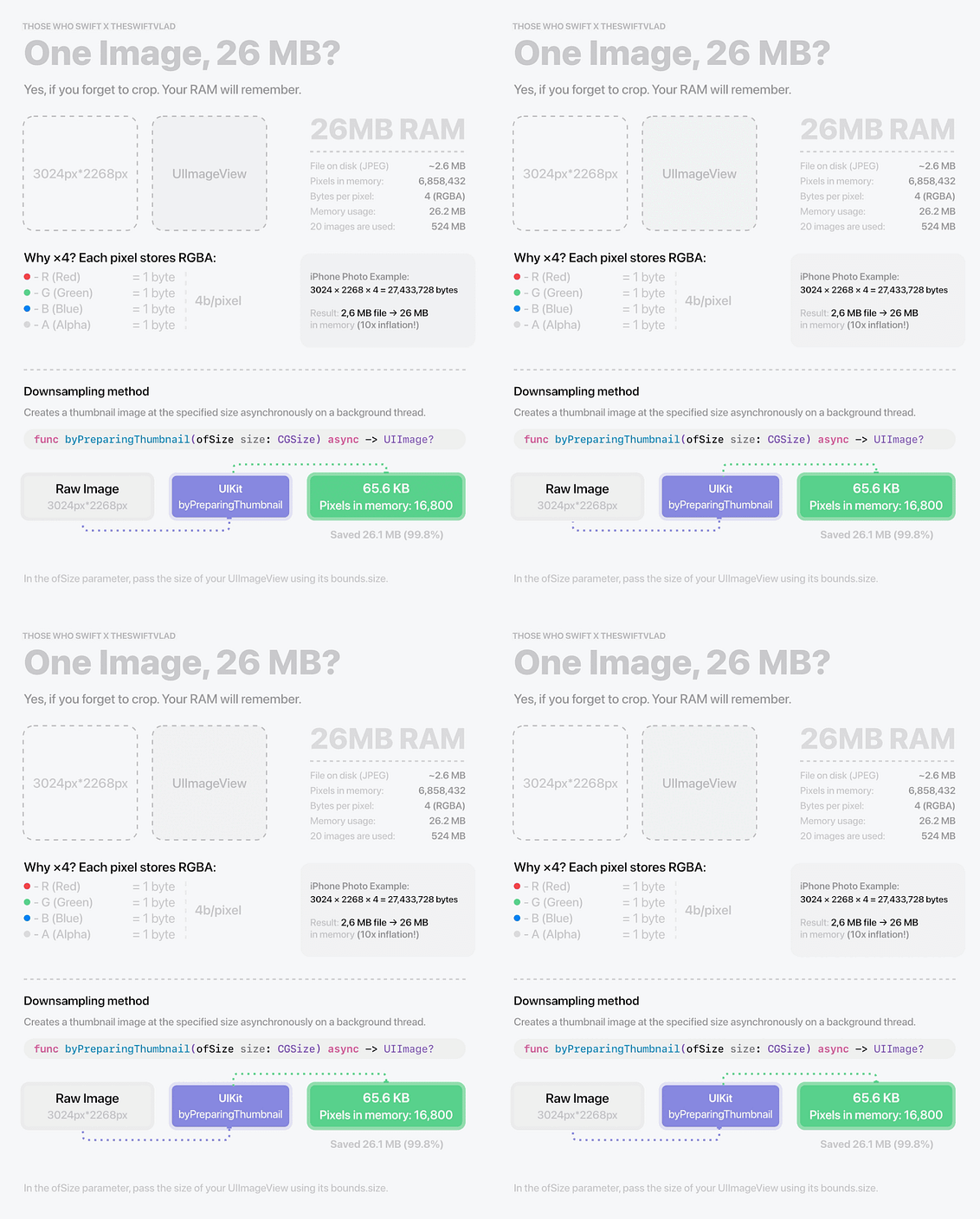
Weekly note ✏️Last week Apple opened the Swift Student Challenge, inviting anyone to submit Playground projects built with modern frameworks and techniques. Traditionally, this contest helps students stand out and get noticed among their peers. This year, however, the context feels different. Participants are not only showcasing their skills but also competing with rapidly advancing AI tools. Spending huge amounts of time on outdated problems with outdated approaches is no longer practical. At the same time, the industry itself is shifting. Fewer companies are offering clear internal growth paths, especially for entry-level roles. You can already hear whispers on forums that the current generation of developers might be the last to write most of their code manually (leaving legacy ecosystems like COBOL or Objective-C aside, of course). Two concerns appear repeatedly: First, AI is absorbing many tasks once reserved for junior developers, weakening the traditional path from junior to mid-level, then senior, and eventually lead or staff. The chain feels broken, and newcomers often have to leap over a gap instead of climbing a ladder. Second, the learning process itself is changing. It’s tempting to rely on AI chats: copy a ticket description, generate a branch, submit a PR. Developers learn how to do something but not why it works. Tools begin to matter more than understanding. Second, your setup is becoming a core part of development. That’s one of the reasons why we launched a new series on iOS Dev Tools blog - Dev Workspaces. A series showing what experts and community leaders actually use in their daily work, from hardware to AI assistants. Our first guest is Natalia Panferova, former Apple engineer and book author. What can help a young and even an experienced developer? How can a single line of code increase your memory footprint by 10×? Here’s a specific method that can significantly reduce memory usage:
Connect with the "Those Who Swift" team - Justas Markus & Anton Gubarenko 👋 Sponsor 🤝Build Hub: your infrastructure upgrade for GitHub ActionsKeep GitHub Actions for CI. Run on mobile-optimized build machines from Bitrise. No migration, no maintenance: just faster builds. Swift Around the Web 🌐Xcode 26.3 + Claude Agent: Model Swapping, MCP, Skills, and Adaptive ConfigurationThis deep dive shows how Xcode 26.3 natively integrates AI agents like Claude Code and Codex, enabling developers to use skills, commands, and MCP tools directly inside the IDE. The article also shares advanced tips such as model swapping, custom tool configuration, and environment-aware prompts to make agent-assisted development more reliable. Container-Based Dependency InjectionArtem Mirzabekian article explains how to implement dependency injection using a container in SwiftUI, centralizing object creation and lifecycle management. It shows how a container improves testability, modularity, and preview setups compared to passing dependencies manually through view hierarchies. Coding 👨💻Morphing Sheets Out of Buttons in SwiftUIGabriel Theodoropoulos demonstrates how to create a smooth morphing transition where a button visually expands into a presented sheet in SwiftUI. By coordinating geometry, animation, and presentation state, you can achieve a more fluid and contextual sheet presentation instead of an abrupt modal appearance. Little SwiftUI Tip: Get View Size Without Displaying ItItsuki demonstrates a technique to measure a SwiftUI view’s size without rendering it onscreen by using layout tools like Apple 🍏App Review Guidelines UpdateApple has clarified that apps featuring random or anonymous chat now fall under the 1.2 User-Generated Content guideline. Developers must ensure proper moderation, reporting, and safety mechanisms to meet App Review requirements. Swift Student Challenge Submissions Are Now OpenApple has opened submissions for the Swift Student Challenge, inviting students worldwide to submit app playgrounds by February 28. The free contest welcomes all skill levels and encourages creative projects that can be experienced in under three minutes using Swift Playgrounds or Xcode. Upcoming SDK Minimum RequirementsApple announced that starting April 28, 2026, all apps submitted to the App Store must be built with the iOS 26, iPadOS 26, tvOS 26, visionOS 26, and watchOS 26 SDKs or later, requiring developers to update their projects and toolchains to stay eligible for submission. Other cool stuff 🧰SwiftUI CoordinatorsNatascha Fadeeva explains how the Coordinator pattern can organize navigation and flow logic in SwiftUI apps, separating routing from views to keep code modular, testable, and easier to scale as screens grow. Measure App Launch Time in iOSThis guide explains how to measure and improve iOS app launch performance using tools like Xcode Instruments and os_signpost. It shows how to identify slow startup work and optimize initialization so your app becomes responsive faster. AI 🤖Agentic Coding in Xcode 26.3 with Claude Code and CodexJordan Morgan explores how Xcode 26.3 brings agent-driven development directly into the IDE, integrating tools like Codex and Claude Code. Using the Model Context Protocol, agents can work with projects, skills, and services, helping developers automate multi-step workflows and prototype ideas faster inside Xcode. Agentic Coding in XcodeAnother vision by Majid Jabrayilov about how Xcode 26.3 integrates AI coding agents like Codex and Claude Code directly into the IDE. With the Model Context Protocol, agents can access documentation, run previews, and reason about your codebase—turning Xcode into a collaborative development environment rather than just an editor. Tutorials 📒Adding an Open Recent Menu in a macOS AppThis guide shows how to implement a standard Open Recent menu in a macOS app using NSDocumentController and menu configuration. It explains how macOS tracks recent files automatically and how to integrate the menu cleanly so your app behaves like a native document-based Mac application. Video 🎥Sharing SwiftData Between UsersStewart Lynch shows how to share SwiftData content between different users by exporting and importing data as JSON through the system share sheet. Using a sample app, it covers encoding relationships, avoiding duplicates on import, and registering a custom document type so shared files open directly in the app. SwiftUI foundations: Build great apps with SwiftUIApple is hosting a full-day SwiftUI learning event from the Cupertino Developer Center, featuring foundational sessions for both beginners and experienced developers. Hear how AllTrails uses SwiftUI in production and join a Q&A with the SwiftUI engineering team to deepen your understanding and performance skills. Thanks for reading Those Who Swift! Subscribe for free to receive new posts.
|